Back to results
Tea Room / Ishikawa Prefectural Cultural Property
Yūgao-tei
ゆうがおてい
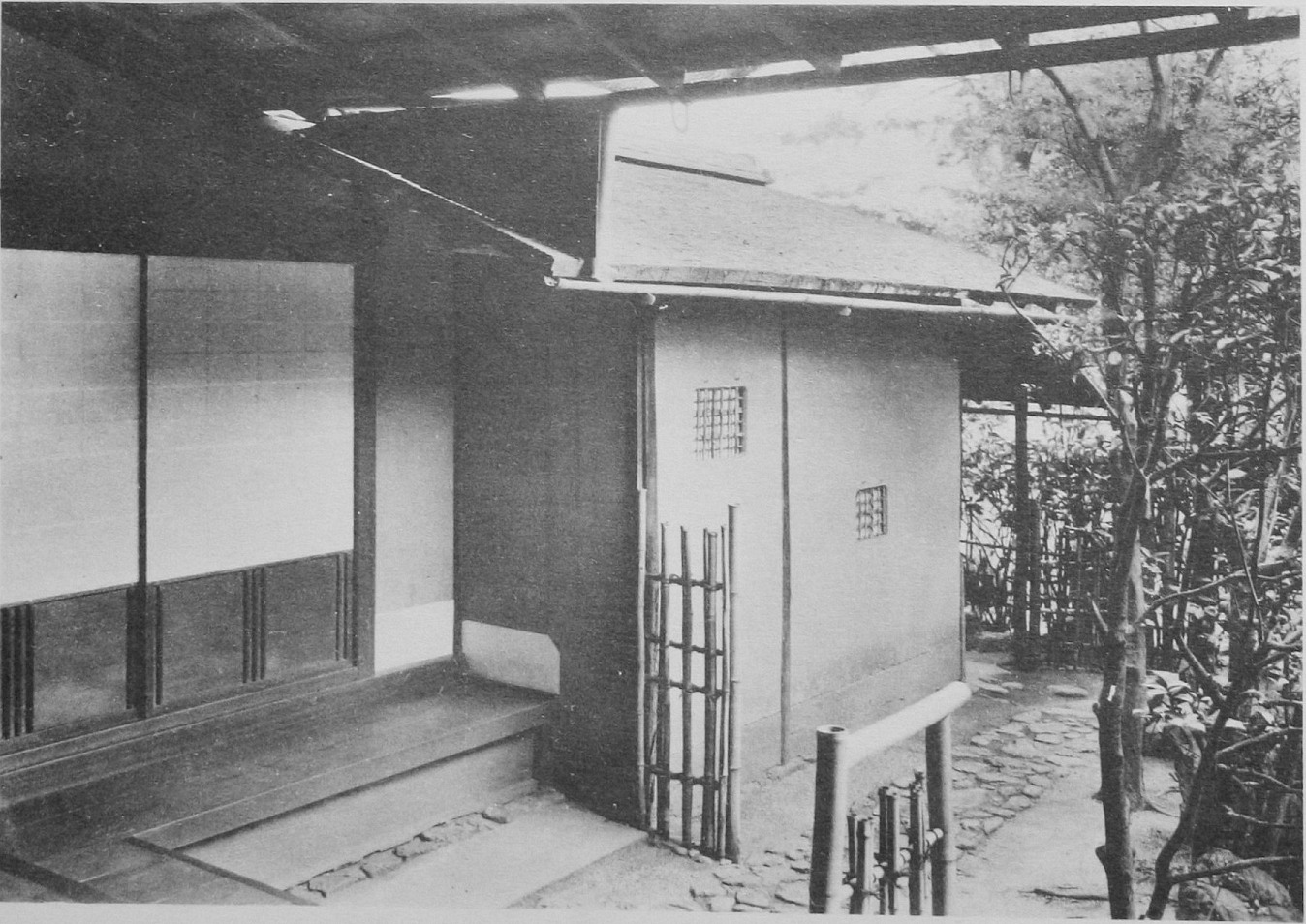
A sukiya built in 1774 by Maeda Harunaga, eleventh lord of Kaga: two small thatched hipped roofs set askew, standing in Kenrokuen's Renchi-tei.
A sukiya building in the Renchi-tei area, regarded as the birthplace of Kenrokuen, built in 1774 by Maeda Harunaga, eleventh lord of Kaga. It has four rooms—tea room, anteroom, mizuya and service room—under two small thatched pyramidal roofs set side by side.
The tea room is a three-mat-plus-daime room with an extra mat for companions, in the taste of Furuta Oribe and of the same lineage as En'an at the Yabunouchi family. Compared with En'an it is far more open, with a board widening the space before the alcove and a veranda in place of walls—designed as a teahouse for viewing the waterfall, fitting for a daimyo garden.
First called the Waterfall-viewing Pavilion or Island Teahouse, it was also known as Hyō-an from the gourd-vine openwork in the alcove wall of the anteroom, and later as Yūgao-tei. It is the only survivor of four pavilions once in the garden. After a period as part of a restaurant, it was partly dismantled and restored to its original form in 1969–70 under the Agency for Cultural Affairs, and was designated an Ishikawa Prefectural Cultural Property in 1989.
GalleryGallery


The Hakuga Dankin water basinThe Hakuga Dankin water basin
By the veranda stands a water basin carved in relief with the tale of the musician Boya, who vowed never to play the qin again after losing the friend who best understood his music. It is large—45 cm high and 85 cm across—and is attributed to Gotō Teijō, a Kyoto metalworker invited by the fifth lord.
The Kenrokuen guide notes that, though small, the room is built for formal tea, and that its name comes from the openwork gourd-flower motif on the wall.
Midori Falls and the Kaiseki Pagoda oppositeMidori Falls and the Kaiseki Pagoda opposite
Across the water, Midori Falls (6.6 m high, 1.6 m wide) drops from Kasumigaike into Hisago Pond with a strong flow and loud sound—the view behind Yūgao-tei's early name, 'the pavilion for viewing the falls'.
On the island in Hisago Pond stands the 4.1 m Kaiseki Pagoda of six pitted capstones. One account says the third lord Toshitsune moved it from a 13-tier pagoda in the Kanazawa Castle garden; another says Katō Kiyomasa brought it back and Hideyoshi gave it to Maeda Toshiie.
How to experience itVisit & use
With Kenrokuen admission you can view the exterior in the Renchi-tei area. No official information on interior viewing or rental was found.
Visitor informationInformation
| Address | 1-1 Kenroku-machi, Kanazawa (Renchi-tei area of Kenrokuen) |
|---|---|
| Hours | Kenrokuen: Mar 1–Oct 15 7:00–18:00 (last entry 17:30); Oct 16–end Feb 8:00–17:00 (last entry 16:30) |
| Admission | Kenrokuen admission ¥320 adults, ¥100 ages 6–17, free for 65+ |
| Access | 12 min by bus from JR Kanazawa Station to Kenrokuen-shita/Kanazawa-jō, then 5 min walk |
Sources (checked 2026年10月)
Tea Room
Interior
Garden
Images are placeholders — no photographs of the cultural properties are shown
Build a tea room like Yūgao-tei
Compare sukiya builders and architects with their past work.
近くの名席Nearby rooms
View all