 Kyoto / Est. 1931Nakamura Sotoji KomutenTea rooms, ryōtei restaurants, museums and private homes — a leading sukiya house working in Japan and abroad.See this builder
 TokyoTsubaki Architectural Design InstituteOver 30 years' experience; designs and builds tea rooms and takes on overseas projects.See this builder
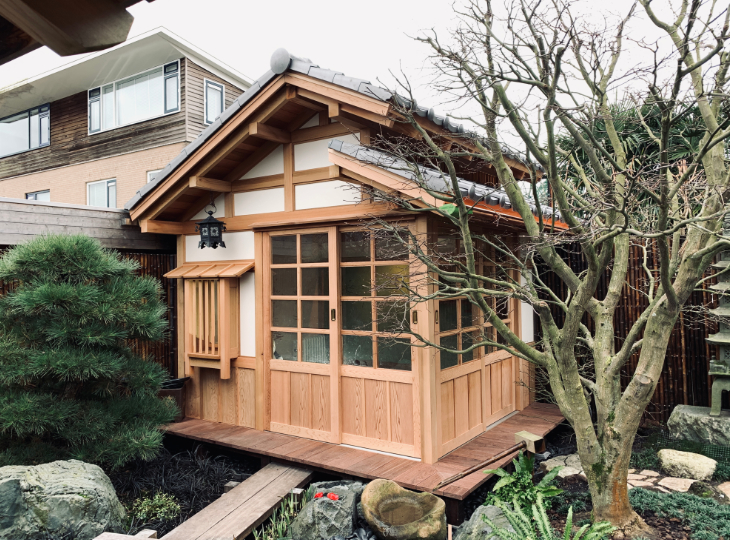 NetherlandsYokoso Japanese GardensHandcrafts tea rooms using traditional methods and ships them worldwide.See this builder
 Ito, ShizuokaKato BikenPortable tea rooms that are easy to move and assemble, also suited to events.See this builder
 KyotoMatsubun ShotenA specialist in fine timber and sukiya materials that also undertakes construction.See this builder
 KyotoMillièmeProvides assembly-kit tea rooms that can be set up in a short time.See this builder
 Kyoto / Est. 1909Yamanaka KomutenPurveyor to Daitoku-ji temple, with global work including a tea house built in Paris.See this builder
Find and compare the companies that build tea rooms.
Search by budget, area and how it's built. No tea-ceremony knowledge needed.
はじめての方へFirst time?
Three questions everyone asks first.
How much does it cost?
From a few hundred thousand yen for a portable room, up to tens of millions for full sukiya work. Here's what the money actually buys.
Read moreCan I build one in an apartment?
Kit and portable tea rooms fit into a corner of a living room — and can be removed later.
Read moreWho do I ask?
Builders, architects, kit makers — the listed companies sorted into six types.
Read more1. Find
Filter by budget, area and type.
2. Compare
Tick the ones you like and see them side by side.
3. Ask
Go straight to each company's site and contact them directly.
Build a tea room
No idea who to ask? That's completely normal.


Slide sideways
 By reservation
Tai-an
待庵
Myōki-an, Ōyamazaki, KyotoNational Treasure
The only surviving tea room attributed to Sen no Rikyū — a two-mat space whose earthen walls distil the very origin of wabi tea.
 Open to visit
Jo-an
如庵
Urakuen, Inuyama, AichiNational Treasure
Oda Urakusai's National Treasure, famed for its bamboo "Uraku window" and a wall papered with old calendars; viewable with the garden at Urakuen.
 Exterior onlySite photo
Mittan
密庵
Ryōkō-in, Daitoku-ji, KyotoNational Treasure
A National Treasure at Ryōkō-in, Daitoku-ji, known for its formal "Mittan-doko" alcove — a pinnacle of shoin-style tea, rarely opened.
 Exterior onlySite photo
Bōsen-seki
忘筌席
Kohō-an, Daitoku-ji, KyotoImportant Cultural Property
A twelve-mat shoin-style tea room at Kohō-an. The lower half of the veranda screen is left open, framing only the roji with its basin and lantern. Rebuilt after a fire in 1793; an Important Cultural Property.
 By reservationSite photo
Hassō-seki
八窓席
Konchi-in, Nanzen-ji, KyotoImportant Cultural Property
A three-mat daime room at Konchi-in, a sub-temple of Nanzen-ji, built in 1628 and an Important Cultural Property. Called "eight windows," it has six; its crawl-in entrance is set toward the centre of the wall.
 By reservationSite photo
Hassō-ken
八窓軒
Manshu-in, KyotoImportant Cultural Property
An Important Cultural Property at Manshu-in: a three-mat daime room with eight windows, counted among Kyoto's three famous tea rooms.
 Exterior onlySite photo
Shōkō-ken
松向軒
Kōtō-in, Daitoku-ji, KyotoTo be confirmed
A tea room at Kōtō-in, Daitoku-ji, traditionally linked to Hosokawa Sansai, holding the austere rigor of a warrior–tea master; open on occasion.
 Exterior onlySite photo
Sa-an
蓑庵
Gyokurin-in, Daitoku-ji, KyotoImportant Cultural Property
An Important Cultural Property at Gyokurin-in, Daitoku-ji: a three-mat room with a centre board, attached to the Nanmei-an built by the Kōnoike family in 1742. Shingle-roofed; generally closed.
 By reservationSite photo
Yodomi-no-seki
澱看席
Saiō-in, KyotoImportant Cultural Property
A three-mat tea room at Saiō-in, a sub-temple of Konkai-Kōmyō-ji, in the taste of Fujimura Yōken and built in 1684–87. A partition wall divides host from guests; an Important Cultural Property.
 Open to visitSite photo
Karakasa-tei & Shigure-tei
傘亭・時雨亭
Kōdai-ji, KyotoImportant Cultural Property
Important Cultural Properties at Kōdai-ji: Kasa-tei, its roof underside spread like an open umbrella, joined by an earthen passage to the two-storey Shigure-tei. Said to have been moved from Fushimi Castle.
 Open to visitSite photo
Kōrin-an
高林庵
Jikō-in, NaraImportant Cultural Property
Katagiri Sekishū's Important Cultural Property at Jikō-in, expressing the trim restraint of the Sekishū school; open with the garden.
 Exterior onlySite photo
Fushin-an
不審菴
Omotesenke, Kyoto
Omotesenke's emblematic room, three mats and a daime mat. Its form goes back to the room Kōshin built in 1646; the present building dates from 1913. Private.
See more tea rooms
Journal
GUIDE · 2026.10
Okubo Toshimichi's Hidden Tea Room: The Historical Significance of Aritai-an
A historical research work on Aritai-an, a hidden tea room used by Okubo Toshimichi during the late Edo and early Meiji periods. This newly published Kindle book explores the political significance and architectural details of this tea room, rediscovered in 2019.
ReadJournal
GUIDE · 2026.10
The two tea rooms of Ohmiya Hachimangu, Suginami: Tsūsen-an and Shinsen-tei
In the bamboo grove beyond the shrine gate at Ohmiya Hachimangu in Suginami stand two tea rooms, Tsūsen-an and Shinsen-tei. Here is what the shrine's own precinct guide tells us.
ReadJournal
GUIDE · 2026.08
Turning a washitsu into a tea room — what actually has to change
A tea room doesn't have to be built from scratch. If you start from a washitsu you already have, here are the three stages of how far to go.
ReadFollow
One tea room a day.
We post a tea room or a builder's work, briefly, every day.